How is a painting created?
Every painting is a relatively technologically demanding process:
First, you need to prepare the canvas. I use only linen, preferably from Central Europe, as it stretches well and is very strong. The stretcher frame is also important; pine plywood is best, as it warps the least.


Linen canvas and stretcher bars
I then glue the frame several times. The glue serves to stretch the canvas and, above all, to insulate the canvas from the paint, which is acidic and would damage the canvas over time. More precisely, it would disrupt the structure of the fibers.
Then I start with the first layer, which serves to lay out the composition, basic color schemes, and underpainting for details. I use only oil paints, which allow for smoother color transitions because they take a long time to dry. Drying usually takes 3-10 days, by which time the paint is almost dry. Ochres dry the fastest, while permanent yellows and reds dry the slowest.


Oil paints in catalogue and reality
I paint the picture in several layers so that the color is both plastic and the texture of the canvas is preserved.


Individual steps in the creation of a painting
When I finish a painting, I let it "mature," i.e., I let the paint dry properly. Then I varnish it, using either a matte or satin varnish. If I know where the painting will be installed, I use "satin" for poorly lit spaces and "matte" for direct light. The very last step is a signature on the back.


Signed paintings in the studio.
Where do the paintings originate?
I sketch paintings more or less anywhere, but there are two places where they originate: in Prague and in Líska a very little village in North Bohemian mountains.


I have one studio in Prague, a rather atypical two-story maisonette with a freight elevator and a surprisingly nice view, which is also due to the fact that the studio is located on the 10th and 11th floors.


The other one is in Líska, a small village where I grew up, and I built the studio myself. It is small, but perfectly adequate.
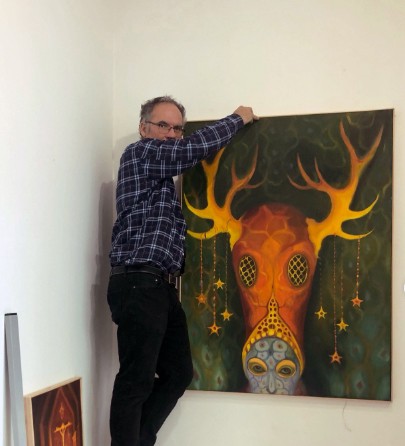
Instalation
When creating an exhibition, it is important to arrange the paintings according to size, lighting, distance, and so on. I usually install with curators with whom I have been working for a long time.
They have a feel for the work and usually know the exhibition spaces and their possibilities very well. It is also very important that they are able to offer a different perspective on the paintings than that of the author.